Friday, 7 November 2014

STOP THE CLOSURES DEMAND A RETHINK


Waiting times soar at West Middlesex Hospital after closure of A&E wards in west London

Hounslow and Richmond councils claim the figures show the hospital is feeling the impact of closures elsewhere, but West Mid says there is no link

West Middlesex Hospital

A&E waiting times at West Middlesex Hospital have rocketed since the closure of nearby emergency wards, but hospital chiefs say the two are not believed to be linked.
The number of patients waiting more than four hours in the A&E department of the hospital in Twickenham Road, Isleworth, has nearly doubled since September 10, when emergency wards at Hammersmith and Central Middlesex hospitals closed for good.
In the month leading up to September 10, an average of 70 patients a week were kept waiting longer than the government target time.
Since then that figure has leapt to 136 per week - an increase of almost 100 per cent.
The new figures were jointly highlighted by Hounslow and Richmond councils, which claim they prove health reforms are increasing the demand for services at West Mid.
Hounslow Council leader Steve Curran said: "I'm deeply concerned about these figures and I fear things may get worse when Ealing and Charing Cross hospitals close their A&Es over the next few years.
"It's crucial NHS London ensures West Middlesex Hospital has enough resources to cope now and in the future from A&E closures."
Nick True, his counterpart at Richmond Council, said: "Richmond and Hounslow councils will continue to work with NHS partners to develop ways to cope with the added pressures on West Middlesex Hospital which includes developing community based services to prevent unnecessary visits to A&E.
"Both councils are united in their determination to fight for a strong West Middlesex Hospital to serve the needs of residents who require hospital care."
The emergency wards at Hammersmith Hospital and Central Middlesex Hospital, in Harlesden, closed as part of a major overhaul of NHS services in north west London.
The team behind the Shaping a Healthier Future programme claim it will save lives by improving care in the community, closer to people's homes, and concentrating specialist care at a smaller number of centres.
But critics of the changes say people could be put at risk because they will have further to travel for care in an emergency.
A spokesman for West Mid said: "Over the past few months we have seen an overall increase in demand for our emergency services, but we believe this is attributable to a generalised seasonal increase being experienced, which we would normally expect.  No direct link with the recent local closures has been established.
"We have a robust winter plan in place and work closely with partner organisations including the London Ambulance Service and other acute trusts to ensure that we maintain service resilience."
He added that the hospital had already taken steps to improve emergency and unscheduled care, following discussions about the impact of changes to health care in the area, and that this work was ongoing.
Get West London

Financial pressures putting NHS trusts at risk, says spending watchdog

‘Deeply alarming report’ from National Audit Office shows future sustainability of NHS is at risk, says MP Margaret Hodge


Margaret Hodge, chair of the public accounts committee, in her office at the House of Commons. Photograph: Shamil Tanna for the Observer


Financial pressures are putting NHS trusts at risk, Whitehall’s spending watchdog has found. It revealed that ministers were forced to find more than half a billion pounds of emergency funds to prop up struggling health trusts last year.
Margaret Hodge, the chair of the Commons public accounts committee, said the “deeply alarming report” showed the future sustainability of the NHS was at risk.
A quarter of NHS and foundation trusts were in deficit by the end of the financial year, with the number in the red rising from 25 to 63 over 12 months, according to a report issued on Friday by the National Audit Office (NAO).
The number of foundation trusts in deficit has doubled from 20 to 41 while the gross deficit of NHS and foundation trusts has increased by 150% from £297.2m to £743.3m, the report said.
The figures – brought together for the first time by independent auditors – will heighten political tensions over the NHS, which is set to be one of the central issues of next year’s general election.
Hodge said: “We all know that when trusts are under this kind of financial stress it is the quality and safety of patient care that can suffer.
“An increasing proportion of foundation trusts cannot meet the terms of their licence, including meeting key measures of quality and outcomes, and the NHS Trust Development Authority had concerns about more than half – 55 of 98 – NHS trusts.”
In the NAO’s third report on the financial health of NHS bodies, auditors sought to identify organisations in financial distress and decide if the NHS as a whole is financially sustainable.
The report found that the Department of Health has now issued £1.8bn in cash injections to 46 NHS bodies since 2006-07, while just £160m has been repaid.
Among the struggling trusts to be bailed out in 2013-14, North Cumbria university hospitals received the highest total of £42m, followed by Peterborough and Stamford hospitals with £40.7m and University hospital of North Staffordshire with £37m. Forty-four health trusts moved from surplus in 2012-13 to deficit in 2013-14, according to the report.
Overall, NHS bodies achieved a net surplus of £722m in 2013-14 – a third of the £2.1bn recorded in the previous 12 months, the report found.
The spending watchdog added that a rising proportion of foundation trusts could not meet the standards met by the healthcare regulator Monitor, with 18% in breach of their licence.
The government allocated £95.2bn to NHS England in 2013-14 to pay for NHS services, the NAO said.
Simon Stevens, NHS England’s chief executive, said: “An ageing population, a growing population and the possibilities of new treatments all mean that pressures are real and we need to get going on the new path set out in the NHS five-year forward view.”
David Cameron has pledged to maintain funding of the NHS for the full five years of the next parliament, if he is in charge, despite that meaning deep cuts in other Whitehall budgets.
Labour said it would give it an extra £2.5bn a year, though there is confusion over when that extra cash would actually be available. The Liberal Democrats are similarly promising to extend the ringfence and give the NHS an extra £1bn a year from 2016.
At £115.1bn, the Department of Health’s budget for next year is due to be just over £2bn more than this year.
Commenting on the report, the department said the NHS budget had increased by £12.7bn since 2010 and most health providers are still in financial balance or better.
A spokesman said: “Financial discipline must be as important as safe care and good performance. Many NHS organisations are already achieving this and all understand the need for greater efficiency.
“Our reforms put power in the hands of local doctors and nurses to make decisions and control their own budgets to make sure patients receive the best services.”

Thursday, 6 November 2014

Hospital workload in one chart: good news, bad news

Trends in referrals and activity over the past six years reflect the success of the English NHS hospital sector. But as our latest quarterly monitoring report highlights, finance directors are feeling very pessimistic about the next twelve months.
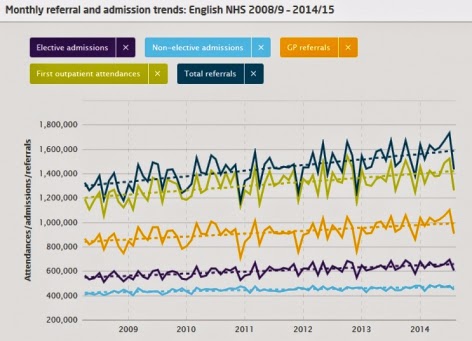
Demand – as measured by total referrals – fluctuates from month to month, but the annual trend shows an increase between 2008 and 2014 of 4.2 per cent. Despite a squeeze on overall NHS funding from 2010/11 onwards – and even tighter pressure on the secondary care sector in particular – between 2008 and 2014, hospitals in England have seen extra referrals in outpatients (up by 3.1 per cent each year) and in elective and non-elective admissions (increasing by 2.8 per cent and 1.6 per cent each year respectively) (see figure 1).
While not reported on a monthly basis (and so not included in the chart below), follow-up outpatient attendances and total A&E attendances have also increased – by around 3.2 per cent and 2.2 per cent a year on average.

Figure 1: Monthly referral and admission trends: English NHS 2008/9 – 2014/15


Hospital workloads are increasing on all fronts. One reason for this is simply that the population has grown over the past six years. Between 2008 and 2014 the population has increased by around 2.2 million people – an average annual increase of 0.7 per cent.

More people are living longer too. For example, since 2008, the number of people aged over 85 has increased by nearly a fifth, which of course has implications for demands on the NHS. Older age groups cost more to the NHS, and when we weight change in population in each age group by the cost to the NHS of each group we can get a more accurate picture of the impact of population change on the NHS. When looked at this way we get an adjusted population change of around 1.1 per cent a year.

So the good news is that, despite a squeeze on funding, hospitals have managed to do more, with activity keeping pace with demographic change. However, there is a cloud to this silver lining. Given these trends and future population projections, demographic pressures will not only continue, but will do so at a slightly increased annual rate than previously.

But these trends show something else is going on. While demographic pressures may be increasing at around 1 per cent or so each year, referrals to hospitals in England have been accelerating at over 4 per cent, outpatients at around 3 per cent, elective inpatients at just under 3 per cent and so on. As other work has shown, population change is clearly just one of the factors driving health care activity.

With current funding getting even tighter next year, workload trends increasing, and with plans in NHS England’s five year forward viewassuming a continuation of the last five years’ productivity goals, the scale of the transformation task for the NHS – and in particular its secondary care sector – is clear.

View the latest quarterly monitoring report

Read the press release for this report: Growing concern about staff morale as NHS performance slips


See our work on NHS funding and finances

30th October 2014

The King's Fund
Comments


#194615 James Cave

Gp

3 Nov 2014

Some interesting stuff but also perplexing. In the first paragraph you seem to imply that funding for secondary care has been particularly hit recently,but not stated compared to what. Also we have no figures her that give any inclining of efficiency. In my experience secondary care is far less efficient and refers far more ptarmigan back to primary care for onward referral. A consequence of the funding mechanism and increasing specialisation of the secondary care sector. Inflation is not necessarily a sign of this sector's success.
reply
back to top


#195038 John Appleby

Chief Economist


The King's Fund


3 Nov 2014


Thanks for your comment James.
Trusts have been hit with real reductions in the tariff over recent years. So, given that and given population change, 'success' in terms of meeting increased demands while under pressure financially. Agree that there are other measures of performance (eg efficiency) that we would also be interested in. However, my closing point is that trends show just how hard it will be to carry out the sort of 'transformation' the FYFV suggests will be needed as money remains tight for another 5 years.
reply
back to top


#205096 Guy Robertson
director
positive ageing associates


5 Nov 2014


it would be more appropriate to balance comments about older people "costing more", with a recognition that older people have contributed more through their working lives. And with rates of employment and entrepreneurship increasing in over 50's they will continue to make an even greater contribution to the NHS. Can you adopt a more balanced analysis please. We need to challenge that older people are going to bring the NHS to its knees. They are not!
reply
back to top


#210940 edward phillips

staff nurse

6 Nov 2014


The demands of patients and relatives are increasing! Any front line nurse (not arm chair nurses or analysts) will know there are increasingly unreasonable demands on the service brought about by labour and conservative governments raising expectations which cannot be delivered in front line clinical practice.

Saturday, 1 November 2014

Queen Alexandra Hospital A&E on ‘black alert’

A ‘BLACK alert’ has been declared as scores of people are queuing in A&E at Queen Alexandra Hospital.

The Portsmouth Clinical Commissioning Group (CCG) said the alert has been in place since Thursday.
It said a black alert is ‘when all actions have failed to contain service pressure and the local health economy is unable to deliver comprehensive emergency care’.
The CCG said this black alert was caused by the Cosham hospital not having enough A&E beds to cope with high numbers of people being admitted, and that at its peak more than 100 patients were waiting to be seen.
This was despite an additional 64 beds being used for urgent care, and routine elective operations being cancelled so that these beds could be used.
Innes Richens, chief operating officer for the Portsmouth CCG, said: ‘Not enough beds has meant long delays in A&E for patients waiting to be admitted or assessed, and many other patients being admitted to wards not specialising in the care they need.
‘At its peak, there were more than 100 patients in this position.
‘This has reduced to about 60 and we are working to reduce this further as a matter of high priority.
‘The reduction has been achieved by all health and social care partners working together to get as many patients home who have finished their hospital care.’
The CCG said it is rare for a health system to be put on black alert, and in the past two years it has only been used ‘a handful of times’ and is usually in place for less than 48 hours.
Measures put in place to bring down numbers include having extra staff, opening up more beds in community places and making sure people have the right support to be treated at home.
Mr Innes added: ‘People with a health concern can also often save themselves time and hassle by going to a local pharmacist, getting a same-day appointment with their GP, or heading to an NHS walk-in centre or minor injuries unit, or NHS 111 for anyone who has a non-emergency health concern.’
Despite months of talks and promises that the A&E crisis is being tackled, demand on the service is still extremely high.
For about 18 months Queen Alexandra Hospital, in Cosham, has been faced with scores of people turning up to the emergency department each day.
The problem first came to light in July last year, when figures showed QA was being fined thousands of pounds for failing to see 95 per cent of patients within four hours and for holding up ambulances in A&E.
As reported, promises were made to ensure things would improve.
When this didn’t happen, Clinical Commissioning Groups introduced the urgent care centre in late November last year.
This involves having GPs in A&E to target patients who don’t need urgent care.
Other measures introduced have included increasing the number of beds available, and holding more daily meetings to identify which patients can be discharged.
However despite these measures, the A&E system has been on ‘black alert’ since Thursday, with no end in sight.

Published on the29October
2014
08:20
The News

Patients should not suffer from closure


More ambulances missing target response times as private spending rockets

The proportion of ambulances failing to arrive within eight minutes has increased by up to a fifth cent in west London


Ambulance waiting times across west London have shot up in the last six months, according to new figures.
The proportion of ambulances failing to arrive within eight minutes of being called in Brent rose from 22 per cent in March this year to 43 per cent in August.
There were also sharp increases in the percentage of ambulances missing the government's emergency response target in other west London boroughs, including Ealing (20 per cent) and Hounslow (15 per cent).
Across London, the proportion of ambulances missing the target doubled to 38 per cent during that period, the latest statistics from the London Ambulance Service (LAS) show.
The huge rise comes as new figures show spending on private ambulances in London has increased tenfold in the last two years, from £795,635 in 2011/12 to £8,841,808 last year.
Labour's London Assembly member Murad Qureshi, who highlighted the statistics, said they showed the huge strain being placed on the LAS at a time when its budget had been cut by £53 million.
"(The increase in response times) means patients with potentially life threatening conditions being left waiting far longer than they should be - the results could be devastating," he added.
"With the NHS in London facing massive financial challenges people will question why we are paying profit making companies to deliver blue light services."
A spokeswoman for the Department of Health said: "Generally, the ambulance service is performing well, arriving in under eight minutes in more than 75 per cent of the most critical cases.
"We know demand is rising, which is why we've employed almost 2,000 extra paramedics since May 2010 and provided £28m additional funding this year.
"Use of the private sector in the NHS represents only 6 per cent of the total NHS budget - an increase of just 1 per cent since May 2010."
PERCENTAGE OF AMBULANCES ARRIVING WITHIN THE TARGET TIME OF EIGHT MINUTES
BoroughTarget hit March 2014Target hit August 2014Percentage change
Brent78 per cent57 per cent-21
Ealing7858-20
Hammersmith & Fulham8165-16
Harrow8163-18
Hillingdon7965-14
Hounslow7560-15
Kensington & Chelsea8372-11
Westminster8570-15
London8162-19

Popular Posts